
054: the one thing AI can't optimize | bob craig
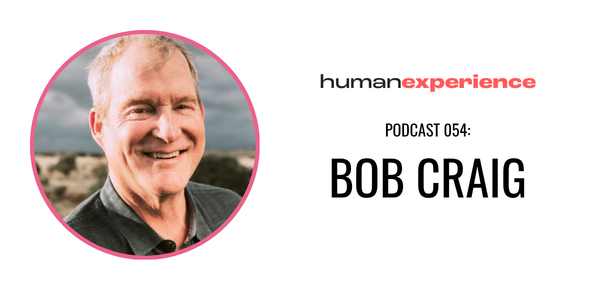
In this episode, Deb Knupp welcomes back one of the HX Collective's most beloved returning guests, Bob Craig, a 40-year technologist and 25-year CIO who has spent the last three years on a deliberate journey of self-discovery.
“My body can process 11 million bits per second. I should listen.”
Bob brings a rare combination of hard-won technical credibility and deep personal reflection, and the conversation that unfolds is one of the most thought-provoking the podcast has produced. Together, Deb and Bob explore what it truly means to be human in an age of accelerating artificial intelligence, not as a warning, but as an invitation.
At the heart of this conversation is Bob's work with the concept of the liminal mind: the practice of getting comfortable living inside unresolved questions, holding tension without fear, and trusting that the way forward will emerge. He draws on the framework of primal intelligence, four distinctly human powers that no algorithm can replicate, and makes the case that understanding our own neural architecture may be the most important preparation any leader or professional can do right now.
Key Highlights
Why Bob describes his three-year retirement as a "highlight reel" and what it feels like to look back on your life with a new emotional awareness that changes how you see every chapter.
The concept of the liminal mind and why getting comfortable in the questions, rather than rushing toward answers, is one of the most powerful cognitive skills a human being can develop.
A breakdown of the four primal powers of human intelligence (intuition, imagination, emotion, and common sense) and why the gap between your conscious mind (50 bits per second) and your subconscious mind (11 million bits per second) is one of the most important facts a leader can internalize.
The reticular activating system (RAS): what it is, why it matters, and how understanding this bundle of nerves at the base of your brain stem can help you make sense of your emotional reactions in real time.
Why the spectrum between dystopian fear and utopian delusion about AI is equally dangerous on both ends, and what a grounded, human-centered relationship with AI actually looks like in practice.
How Bob uses a multi-role AI prompting model (activator, skeptic, first principles thinker, antagonist, CEO) to simulate the kind of diverse perspectives he used to manage as a CIO, and why he sees this as a parallel to leadership, not a replacement for it.
The Liminal Mind Cohort: what Bob has built, why vulnerability is the real power move in a peer community, and what it means to show up authentically in a space designed for deep self-discovery.
The perspective shift as a daily practice and why teaching an eight-year-old to journal two perspective shifts a day gives Bob more hope for the future than almost anything else he has encountered.
About Our Guest
Bob Craig is a retired 40-year technologist and 25-year Chief Information Officer who led technology strategy at the highest levels of the legal industry. Since stepping away from his executive career, Bob has devoted himself to a deliberate journey of self-discovery, exploring the intersection of human cognition, emotional intelligence, and the future of AI through the lens of primal intelligence and the liminal mind. He is the founder of the Liminal Mind Cohort, a small-group experience designed to help professionals develop the inner capacity to navigate uncertainty, lead with authenticity, and flourish in the age of AI. Bob's thinking draws on the work of Angus Fletcher at Ohio State, whose research on primal intelligence informs the four human powers at the center of this conversation.
Connect with Bob Craig:
Interested in joining the next generation of the Liminal Mind Cohort? Reach out to Bob directly via LinkedIn: https://www.linkedin.com/in/bobecraig/
Read Angus Fletcher’s book, Primal Intelligence
About the HX Collective
The HX Collective explores the human experience through three lenses: work, relationships, and self, through raw, authentic conversations rooted in human-centered design. Each episode offers gripping stories, thought-provoking discussion, and concrete tools that help you rethink your relationship with distress and strengthen your whole human experience.
